There is clearly an NHS policy around IVF, that states not to overwhelm the patient with too much information. This means my questions of ‘and what happens after that’ are met with ‘you don’t need to know that yet’. As an autistic woman this is really unpleasant for me. In part because I naturally need more information than other people to feel I have understood something, and also because knowing the full picture is important for me to feel I have control. And while I don’t know how a non-autistic woman might feel, it seems to me that most people would want to know what was going to be happening to their bodies.
Because of this policy I had to push incredibly hard to get the answers I wanted. After being told ‘you don’t need to know’ and insisting again and again that I did, finally a nurse realised how much it was stressing me out not having all the information, and answered my questions. Even then she was surprised when I started writing it down, but I’ve referred back to my notes so many times. They help me to understand the process, and know where I am in it, helping me to feel grounded and reducing my stress levels.
Beyond that, in a practical sense I could do with knowing how many appointments I will have, and roughly how long they will be. As, if I use up all my IVF leave, I will have to take holiday, and to take holiday I need to not use it on other things… I just can’t see the benefit of information being held back from me.
The meeting at which I finally got my answers was that with the nurse, to go through the medication I would need to take. The hormones are administered via injections, at home, so myself and Chris had to be taught what to do with which injection. We were given three hormones, each with a different method for administering and each to be taken at different times.
Firstly, I had to come off the pill, which I had been put on to control my cycle. Five days later I headed to Sheffield for an internal ultrasound. This was to check the lining of the womb was nice and thin, and to make sure there were more than three follicles in my overaries. The trainee nurse, and her supervisor, took one look at my womb and exclaimed ‘Lovely! That’s absolutely textbook, a nice and thin lining.’ Laying on my back with no pants on I wondered if I could take that as a compliment, or if it was too out of my control to be flattered.
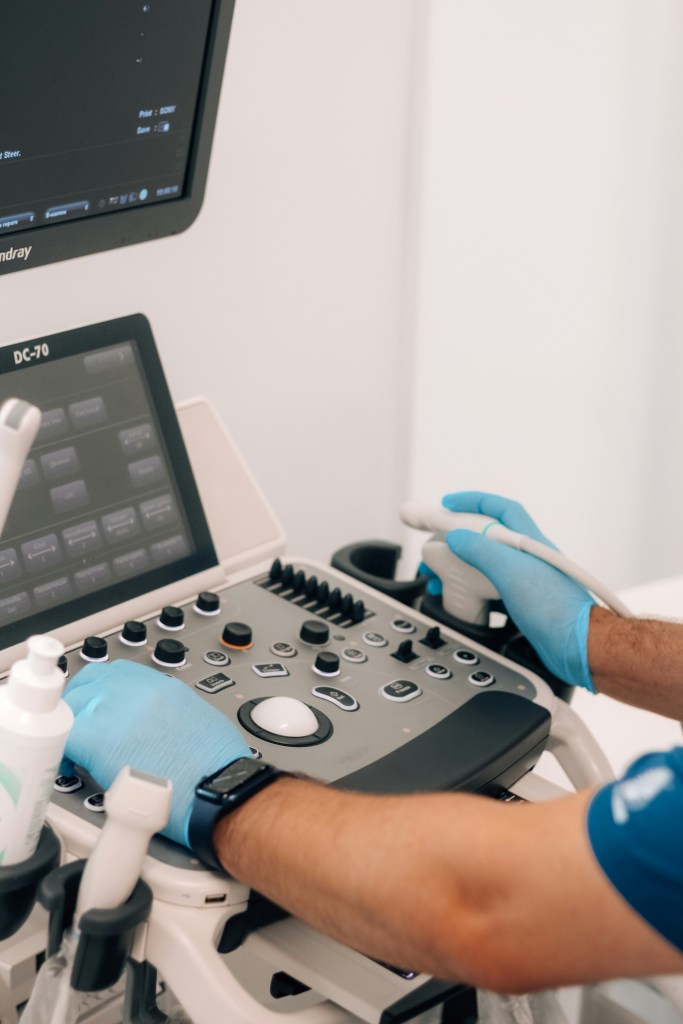
Next they counted the follicles, which looked like big black holes in the middle of a small circle on the screen (the overaries). Twelve in total. I asked if that meant there would be 12 eggs, but they said they couldn’t know yet, just that it was a good number.
Follicles are fluid filled sacks the eggs sit within. When the body tells the ovaries to start maturing the eggs, the follicles grow and help the egg develop. When I was first told about follicles I thought of hair follicles, thinking they would be little stems the eggs were attached too. Honestly I pictured the nature documentary images of polyps on corals releasing their eggs, but turns out its nothing like that and David Attenborough won’t be narrating.
With my clothes back on I was sent off to the pharmacy to collect my drugs. It cost £30 for all my IVF hormones. Personally this isn’t a sum of money I have to worry about, but I did think it unkind to offer free IVF but make people pay for their drugs. For many families an unexpected £30 bill, plus the cost of getting to the hospital, could be very unpleasant. Perhaps at least telling patients what the costs would be upfront would be useful.
Back home I went, with a bag of needles. My first hormone, to be injected after 6pm every night, was a FSH (Follicle-stimulating hormone). This stimulates the growth and maturation of the follicles, and therefore the eggs. The pen looks similar to an epi-pen, and is pre-filled. All we had to do was twist the cap to the right dose, inject and press down.
When talking me through the hormones the nurse had directed everything at me, but I’d pointed out Chris would be doing the injecting. I don’t like needles and I wasn’t sure I could will myself to do it. She looked at me slightly puzzled ‘it’s a very small needle’ she said, indicating the 3cm long metal point. It’s not the length, however that’s the problem. It’s the fact that it tears through the skin. I could handle any sized needle if it didn’t have to puncture me. There’s also the unknown quantity of pain, as every injection is different, and you never know how much pain there will be.
Chris wasn’t overly happy about having to inject me, given that he doesn’t like needles either. So together we sat down to do something unpleasant. The injection goes into the belly fat, Chris squeezing a roll between his fingers and injecting into it. I’ve been feeling a little too squishy on my belly lately but I’m pretty glad of it now – I wouldn’t want to be injected into a washboard stomach.
There was a little pain with the injection, but it was over quickly. I’d been warned the injections might make me hormonal, so I waited to see if I would transform into a Mr Hyde. I think men don’t often appreciate what being hormonal means for many women. Personally, I can have one or two days of intense depression a month due to my period. I know what it is so I can power through, but I’d really rather not have it. So while the TV likes to portray pre-menstral woman as unpleasant bullies, the fact is that the sadness that comes with hormonal fluctuations just isn’t very funny. And a week of it didn’t appeal.
However, while I did feel a little sick, and a little achy after each injection, the hormonal chaos appeared to remain well contained. I was particularly happy about this as we had a guest staying for the week, helping with DIY on the house. I had booked a few days off to join in the manual labour, so I kept an eye on myself to see if I should rest, but all in all I felt OK.
Injecting the FSH continued every night till I returned to Sheffield for my second scan. In the meantime, having started the FSH on the Friday, I started a new hormone on the Wednesday. This hormone was to stop my body from moving forward with its natural cycle.
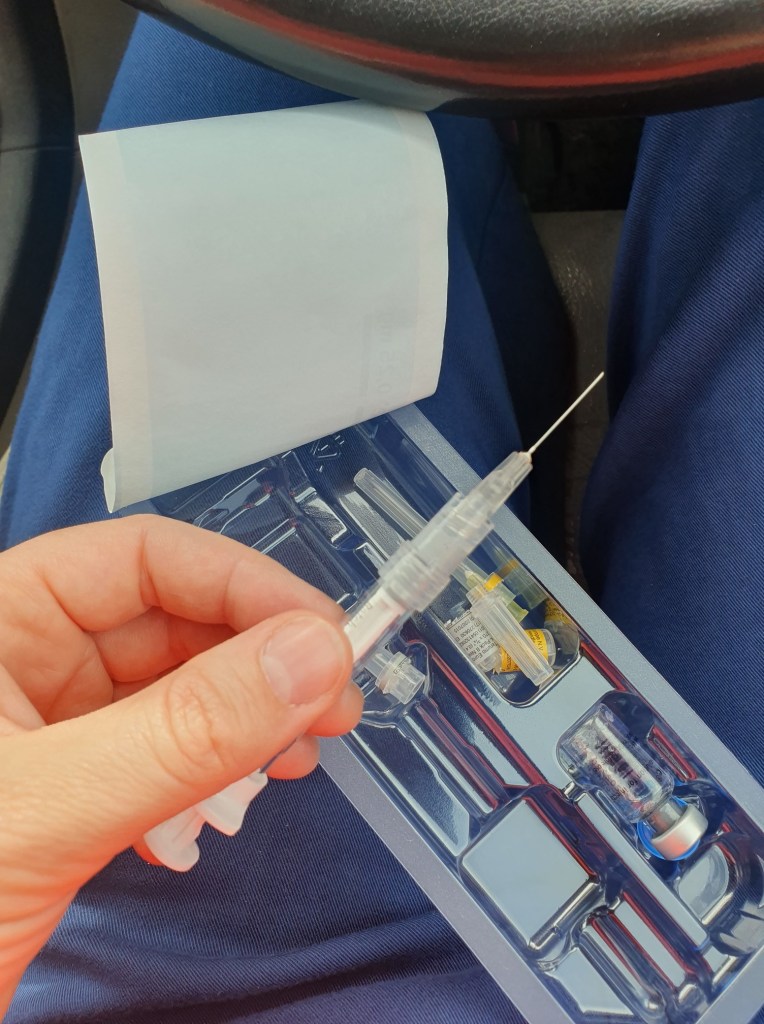
This hormone was more complex to deliver, with a powder in a vial and a liquid in a syringe needing to be mixed and the pulled back into the syringe to be injected. It was a bigger needle and looked like a lot more liquid, so I was a little nervous, but in the end it wasn’t half as bad as I thought. The injection was actually less painful than the first, though I did feel more sore afterwards.
And on day five I even managed to inject myself! It took a lot of willpower and a little self-delusion to push the needle in to my skin, but I managed it. I don’t think any of this will undo my fear of needles, but at least I know I can overcome the phobia in an emergency.
A week after starting the injections I was back to Sheffield for another internal scan to assess if the follicles had matured. The left overary was pulling its weight but apparently the right was lagging behind. Still 16 follicles in total. If all had been ready I would have been off to London on Monday, but instead I needed to return for another scan on the Tuesday.
My Tuesday scan was with another nurse, who had a slightly less polished bedside manner. Add to this the fact that my overaries were now quite tender, meaning the internal scan was like pressing on a bruise, and the fact another student nurse had joined, making an audience of three, it wasn’t the most enjoyable appointment. Still they said everything was good to go and I’d have to ring up later that day to confirm my appointment at Guy’s hospital for the egg harvesting.
The final day was Thursday at 12pm. This meant travelling down to my parents on the Wednesday night, leaving the dog, and getting the train to London to stay the night at a Premier Inn. The previous night, on the Tuesday, we’d had to administer the third and final hormone at the late hour of midnight. This is the trigger injection, a final boost to mature the eggs ready for harvesting.
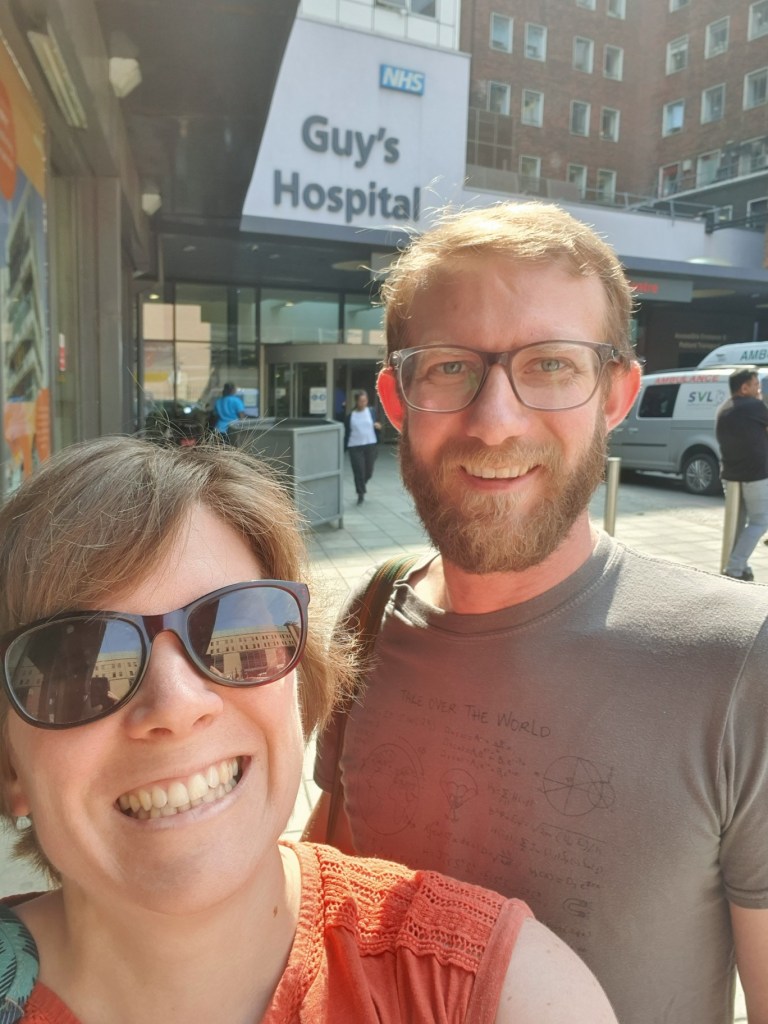
In London we heading to Guys hospital for 11.30 and wandered up to the Assisted Conception Unit. The whole place looked shiny and new, which is always reassuring. The views over London were lovely. We were sent to a waiting room and then brought through to our own little curtained off room for me to change into my gown and hat.
Chris was soon ushered off to give his ‘sample’ (ha ha wink wink), and have his bloods check for Hep B, C and HIV. This needed to be done for both of us 3 months prior to egg collection, however though we’d both done it at the same time in Sheffield they must not have gotten Chris’s results.
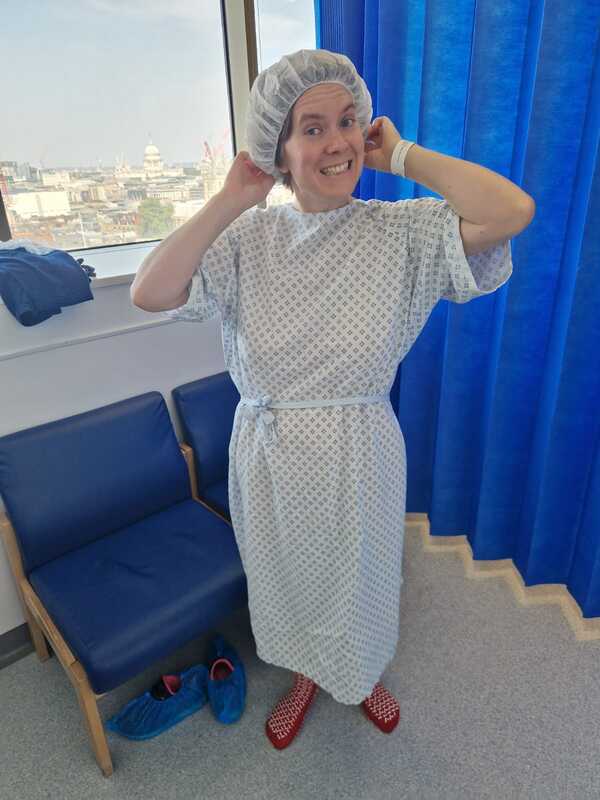
Looking all fancy in my surprisingly comfortable robe, I was taken into the operating room. Here I was fitted with a canula in the back of my hand for the general anaesthetic, and the nurse attached sticky pads to my chest to monitor my heart.
Legs then went up in the stirrups and they injected the general anaesthetic. I felt a little cold in my arm and a funny taste appeared in my mouth. Very quickly the ceiling started to spin. Next thing I was being told it was time to wake up and I was back in the room with Chris.
The method for collecting the eggs is through a ultrasound guided needle, inserted through the vagina. The needle is used to pop the follicles and draw in the eggs. So very minimally invasive. Some bleeding and pain are natural afterwards, but a few days of rest should be enough to get over it.
The whole process was very smooth and comfortable, and all the doctors and nurses kept me constantly updated on what was happening, so I felt fine throughout.
Having not eaten or drunk since the night before I sat in my bed, drunk my water and ate a pain au chocolate. I did feel a little out of it and dizzy, but nothing too serious. They’d given me painkillers while I was under so I didn’t feel any real pain, just some soreness.
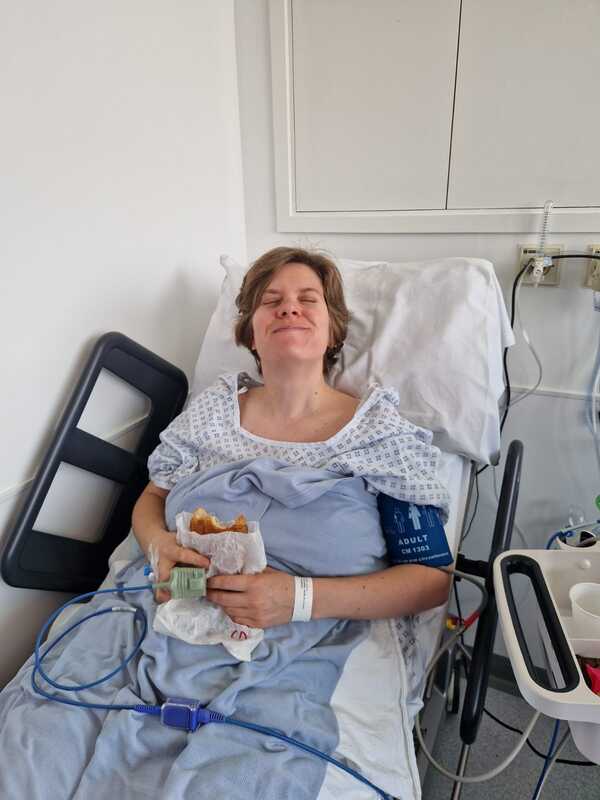
After a little time a doctor came to see us to tell us the good news. There had been 15 eggs collected, and Chris’s sperm sample was also good. The next step would be to fertilise the sperm by injecting one healthy looking sperm into one egg. In the next five days we would then hear how many had fertilised. They will then be grown on as embryos till there are five cells, at which point they can be biopsied and frozen.
It will be several months before we know how many are PKD free. Technically it should be a 50/50 split but things don’t tend to be that straightforward.
As well as staying in London the night before, we were advised to stay the night after the procedure, incase of complication, but I really didn’t feel like lazing around a hotel room when my parents were so close. Plus the trip had already cost us over £250 with hotel rooms and train tickets so I didn’t fancy paying for another nights stay. Having got the OK from our nurses we decided to head back to my parents and stay the night there instead.

It’s a relief to get this part of the process over and done with, not just as it’s the most involved part of the procedure, but also because we didn’t know how successful it would be. If we hadn’t gotten any eggs we would have had to start all over again. But with 15 we’ve got a good chance of success.
Once again I can only think how lucky we are to live in a place where this procedure is not only legal but free. And so far we’ve even been lucky enough for it to be going smoothly. Of course it’s not over yet, but so far so good.
 Other ways to make a baby
Leave a comment